Google's Virtual Try-On Tool: You Can Now Try On Shoes with AI

Google is taking online shopping to the next level. The company has expanded its virtual try-on shopping tool, now allowing users to see how shoes look on them using AI — a move that pushes the boundaries of how people shop online.
A Step Forward in AI-Powered Shopping
Originally launched for clothing, Google’s AI virtual try-on tool now includes footwear, giving users the chance to visualize shoes directly on their own photos. The feature is rolling out to more countries, including Australia, Canada, and Japan, expanding access to a growing trend in augmented reality (AR) shopping.
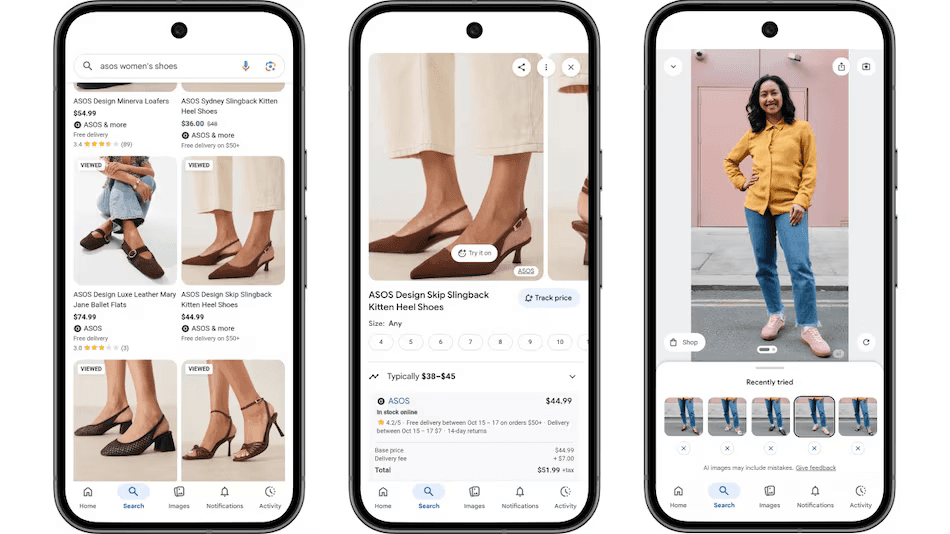
To use it, shoppers can open a product listing in Google Search or Shopping, tap “Try It On,” upload a full-body image, and instantly see how the shoes would look on them. It’s a fast, simple, and surprisingly realistic experience that combines computer vision, 3D modeling, and AI rendering.
Why Google’s Virtual Try-On Matters
Reducing uncertainty when shopping online
Fit and style are among the biggest challenges in e-commerce. Being able to see how a pair of shoes looks before purchasing helps shoppers feel more confident, reducing guesswork and return rates.Increasing engagement and conversions
Visual interactivity keeps users on product pages longer. Early results suggest that shoppers who use try-on tools are significantly more likely to complete a purchase.Improving sustainability through fewer returns
Every return means extra shipping, packaging, and carbon emissions. AI try-ons can cut down unnecessary returns, making the online shopping experience more eco-friendly.Accelerating the future of AR in retail
Google’s continued investment in visual search and AR shopping tools signals that the future of retail will be deeply immersive. Seeing is believing — and soon, trying on virtually might become standard for every major brand.
How the Technology Works
Google’s virtual try-on uses a neural rendering model that maps product imagery to real human photos. The system understands body proportions, lighting, fabric texture, and material behavior, making the try-on look strikingly natural. The technology builds on years of progress in visual understanding, 3D consistency, and generative AI, giving each user a personalized and realistic preview.
The Bigger Picture for Online Shopping
This expansion marks another step in blending AI with e-commerce. It’s not just about virtual fashion — it’s about bridging the gap between the screen and the shopper. From AR clothing previews to AI-driven recommendations, retail is shifting toward hyper-personalization powered by machine learning and computer vision.
As tools like Google’s virtual try-on evolve, the distinction between online and in-store shopping continues to blur. Soon, “trying something on” might mean just holding up your phone.
Feb 16, 2026